

Choose a home services marketing agency that turns local searches into booked jobs, not just clicks. What to ask, what it should cost, and how to measure ROI.
How to Choose a Home Services Marketing Agency
Choose a home services marketing agency that can show how it turns local searches into booked jobs, not just clicks and leads. Ask how it will attract the right customers, handle missed calls and estimate follow-up, and track revenue back to each marketing channel. Make sure you know who owns the work, what you will pay, and which results you will see each month.
I'm Nikolaos Stafford, founder and CEO of Four Pillar Marketing. My decade-plus experience connecting growth strategy, demand generation, and revenue operations shapes the questions in this guide.

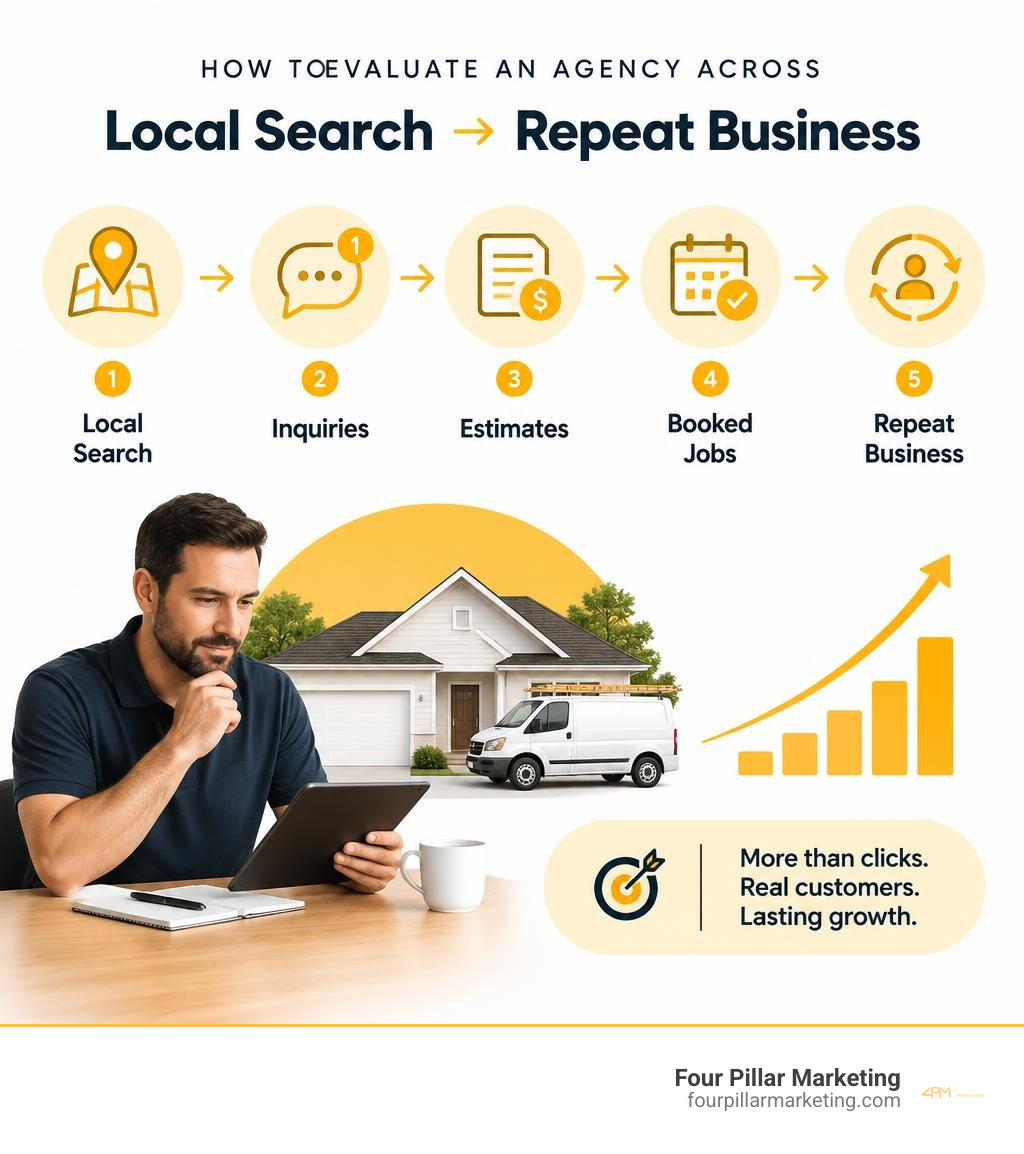
Use the framework above to evaluate any agency across the full path a homeowner takes: local search, inquiry, estimate, booked job, and repeat business.
What a home services marketing agency should handle
A good partner does not just "do marketing." It connects the pieces that put a truck in a driveway: growth strategy, brand, SEO, paid media, funnels, CRM, AI automation, videography, and revenue operations. When those pieces live with five different vendors, nobody owns the result, and leads fall through the cracks. That is why we built Four Pillar Marketing around one team and one invoice.

You can see how our relevant home services marketing services fit together, or browse our marketing solutions for service businesses if you want to start from a business problem instead.
The stakes are real. The home services industry was projected to reach $1.2 trillion in revenue by 2025, and 97% of consumers search online for local home services. If you are not visible and easy to book when they search, someone else gets the job.
What should a home services marketing agency include?
Here is the checklist we would hand any owner:
- Local SEO, Google Business Profile management, and service-area pages
- Review management, including requests and responses
- Google Ads and Local Services Ads
- Social advertising and retargeting
- Landing pages and conversion optimization
- Call tracking, so you know which ads make the phone ring
- Email and SMS follow-up
- CRM workflows that keep leads moving
- Video that builds trust before the first call
If an agency offers only one or two of these, ask who handles the rest.
How is home services marketing different from general digital marketing?
General marketing chases awareness. Home services marketing chases a homeowner with a leaking water heater who wants help today. The differences show up quickly:
- Service radius: Clicks from outside your area are wasted money.
- Urgent intent: Speed matters more than clever slogans.
- Seasonal demand: HVAC, roofing, and landscaping swing with the weather.
- Call-based leads: Many jobs begin with a phone call, not a form.
- Capacity limits: Dispatch and technician availability decide how many leads you can actually serve.
- Job value and reputation: One big job can pay for a month of marketing, and neighbors trust neighbors.
Our home services industry needs page explains how we build around these realities.
How a home services marketing agency turns local demand into booked jobs
The path is simple to describe: a homeowner searches, finds you, contacts you, gets an estimate, books, and hopefully comes back. Every step can leak. Great agencies find the leaks, such as slow response, missed calls, and estimates that never get a follow-up text.
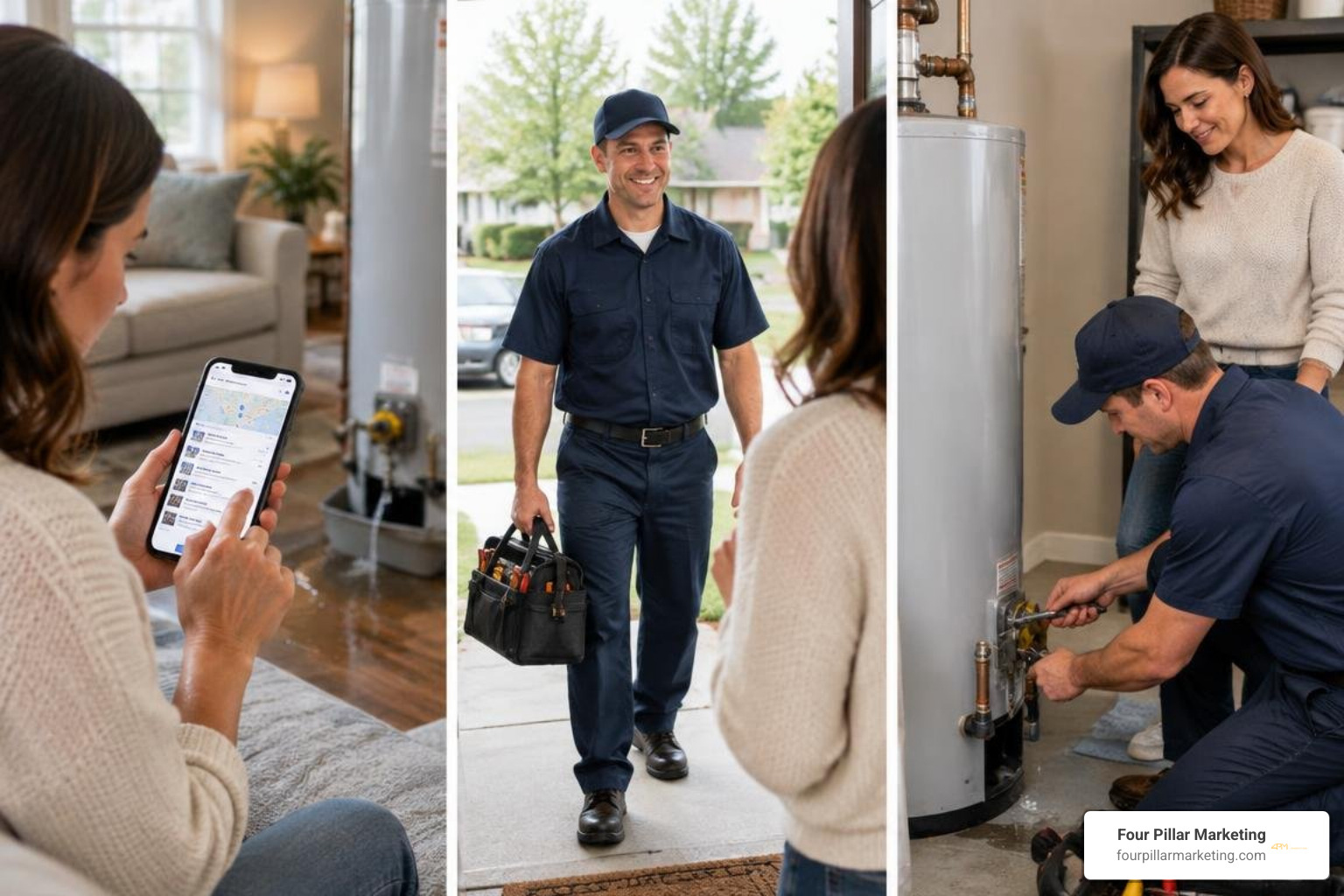
Funnels matter here. Our guide to high-converting service business funnels shows how a focused page and a fast follow-up sequence beat a generic homepage. Google also explains ways to improve your local ranking on Google, which is a useful baseline for any agency conversation.
How does a home services marketing agency improve lead quality and conversion?
Lead quality starts before the click. An agency should build service-specific campaigns, target the locations you actually serve, and add negative keywords so you stop paying for searches like "free HVAC training." Then the landing page must match the promise of the ad, with short forms and a clear phone number.
Benchmarks from our research show why the channel mix matters:
- Home service businesses investing in SEO see an average 14.6% conversion rate, compared with 1.7% for traditional outbound methods.
- Paid search ads average a 200% ROI, with a cost per lead of $48 to $60.
- Companies using an agency see about 3.5x more leads than those handling marketing in-house.
Treat these as directional, since your trade and market will vary. Qualification matters too. A good agency helps you screen for service type, location, and urgency, so your team spends time on real jobs.
How does an agency improve local SEO and online reviews?
Local SEO is mostly careful, repeated housekeeping. An agency should:
- Set up and optimize your Google Business Profile with the right categories and service areas. Our Google Business Profile setup guide covers the basics.
- Keep your name, address, and phone number consistent across local citations.
- Build service and city pages that answer real questions.
- Ask every happy customer for a review, right after the job is done.
- Respond to every review, good or bad, professionally.
Review velocity, meaning how steadily new reviews arrive, matters as much as the total count. A steady stream signals an active business. For regional context, see our local SEO for Gulf Coast service businesses article.
Which paid advertising and retention tactics should be included?
For new demand, expect Google Ads for high-intent searches and Local Services Ads for trust-driven placement. Local service ads have a 4.5% click-through rate, far above the 0.35% average for display ads. Add retargeting and social ads to stay in front of people who looked but did not call, and use call tracking to see which campaigns produce conversations.
Retention is where profit hides. Winning a customer once is expensive; winning them again is cheap. Look for:
- Maintenance reminders and seasonal promotions
- Email and SMS campaigns, since email averages a reported ROI of $42 for every $1 spent
- Referral campaigns
- Repeat-booking workflows
These run best on CRM workflows for small businesses, so follow-up happens even when your team is on a roof.
Video helps on both sides. Research shows it can lift lead generation by 66%, and 84% of consumers say a video convinced them to hire a service. Our guide to marketing video planning is a good place to start.
How to evaluate agency fit, investment, and ROI
Here is how the three common options compare:
| Option | Scope | Coordination | Best fit |
|---|---|---|---|
| Full-service agency | Strategy, SEO, ads, funnels, CRM, video | One team owns the whole path | Owners who want growth without managing vendors |
| Specialist agency | One channel, such as ads or SEO | You coordinate between vendors | Businesses with strong internal marketing leadership |
| In-house marketing | Whatever your hires can cover | Direct, but limited by headcount | Larger companies with steady budgets |
Whichever route you choose, look for service-area experience, trade experience, a named account owner, a clear reporting cadence, CRM access, and honest attribution. Our guide on agency selection criteria goes deeper.
What should owners look for in a home services marketing agency?
- Relevant experience: Ask for examples in your trade or similar service businesses.
- Transparent reporting: You should see leads, bookings, and revenue, not just impressions.
- Lead tracking and sales alignment: The agency should care what happens after the form submission.
- Clear deliverables and realistic timelines: Beware anyone promising page one in two weeks.
- Fair contract terms: You should own your accounts, data, and content.
- Communication and capacity planning: Marketing should not flood a crew that cannot serve the work.
For a deeper checklist, read our full-service agency evaluation. If you are local to Louisiana, our guide to agency selection in New Orleans applies too.
What budget and ROI should a business plan for?
Budget has several parts: the monthly retainer, ad spend paid to platforms, setup fees, and creative costs such as video. Keep ad spend separate in your mind, because it funds the leads while the retainer funds the strategy and execution. See our agency pricing for how we structure it, and our guides on monthly marketing agency costs and how much to invest in marketing.
To judge ROI, use plain math. Customer acquisition cost equals total marketing spend divided by new customers won. Compare that with average job value, gross margin, and close rate. If a job earns you $600 in gross profit and costs $150 to acquire, the channel works. Also track payback period, meaning how long until a campaign earns back its cost. SEO usually takes months to build, while paid search can produce leads sooner but stops when spend stops.
Which metrics reveal whether marketing is working?
Track what leads to revenue:
- Qualified leads, calls, and form submissions
- Booked estimates and answer rate
- Speed to lead, meaning how fast you respond
- Close rate and cost per booked job
- Customer acquisition cost and revenue by channel
- Repeat rate and review growth
- Reporting accuracy, so numbers match your CRM
If an agency reports only clicks, keep asking "and how many jobs?"
How can an agency address common marketing challenges?
- Seasonality: Plan promotions and maintenance campaigns to smooth slow months.
- Service-area competition: Use tight targeting, strong reviews, and local content.
- Inconsistent follow-up and missed calls: Automate text-backs, reminders, and estimate nudges.
- Unqualified leads: Improve ad copy, negative keywords, and screening questions.
- Limited capacity: Throttle campaigns to match your crew.
- Fragmented vendors and weak attribution: Put strategy, tracking, and CRM under one roof.
- Outdated websites and review gaps: Refresh pages and build a review routine.
- CRM adoption: Keep the setup simple so your team actually uses it.
Our overview of outsourced marketing support explains how this works day to day.
Frequently Asked Questions about Home Services Marketing Agencies
How long does home services marketing take to produce results? Paid search can generate calls within weeks, though it needs testing and adjustments. SEO typically takes several months to build momentum. Results also depend on lead follow-up and seasonality, so judge performance over a measurement window of a few months, not a few days.
Should a home services business hire an agency or build an in-house team? It depends on team capacity, the specialist skills you need, and who will own coordination. One hire rarely covers SEO, ads, video, CRM, and reporting. An agency brings a full bench, while an in-house team offers closer daily control. Match the choice to your business goals.
What should be included in an agency's monthly report? Expect lead sources, qualified leads, booked jobs, cost per acquisition, revenue, and next steps. The report should explain what changed, what you will do about it, and what it means for your calendar.
Conclusion
The right agency fits your trade, your service area, and your capacity, and it connects marketing to sales so growth is measurable. Ask hard questions about follow-up, attribution, and ownership before you sign anything. If you want one team to handle strategy, SEO, paid media, CRM, and video, explore Four Pillar Marketing and let's talk about your next booked job.
Let's map your 90-day growth plan
Book a free 30-minute strategy call. Walk away with a customized roadmap — whether you work with us or not.
Book Strategy Call